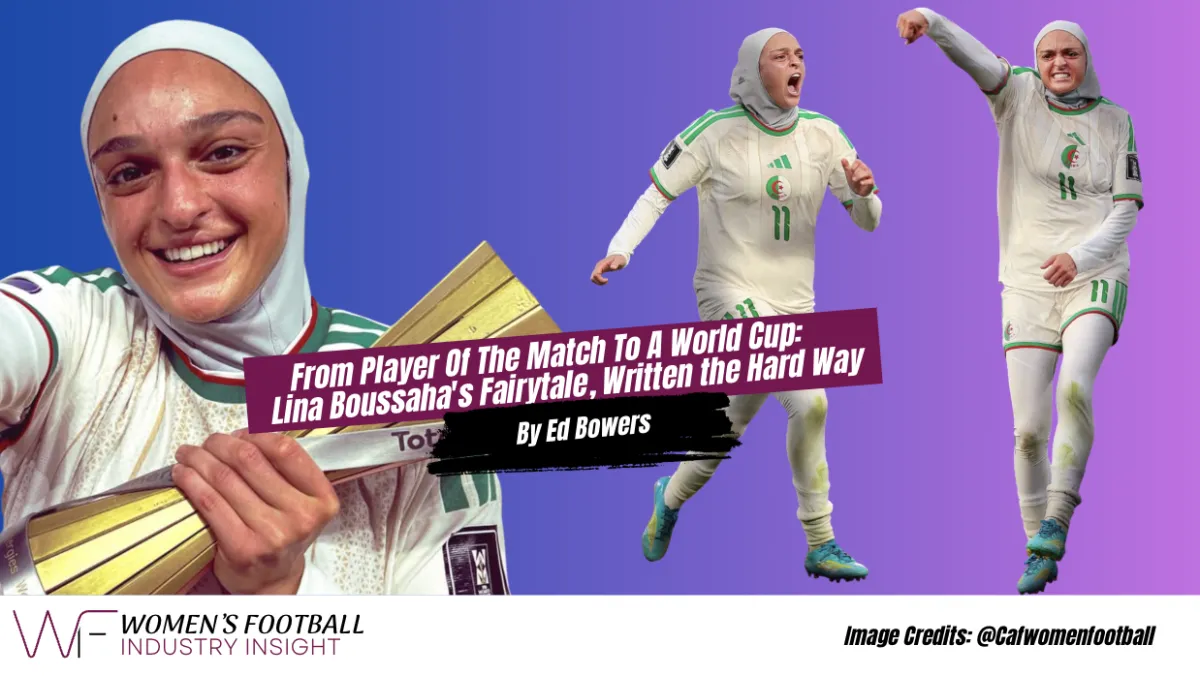
From Player Of The Match To A World Cup: Lina Boussaha's Fairytale, Written the Hard Way
There is a moment, late in the WAFCON 2026 bronze medal match between Algeria and hosts Morocco, that tells you everything you need to know about Lina Boussaha. Algeria are down 1-0. The clock is running out on a tournament that has already rewritten the country's football history. And in the 83rd minute, it's Boussaha who finds the equaliser — 1-1, straight into penalties, where Algeria hold their nerve to win 3-2 and claim the first WAFCON medal in the nation's history. She was named Woman of the Match. It capped a tournament in which Algeria also beat Côte d'Ivoire in the quarter-finals to qualify for the 2027 FIFA Women's World Cup in Brazil — their first ever World Cup appearance.
I'm not writing this as someone reacting to a highlight reel. Weeks before a ball was kicked at WAFCON, Lina sat down with me on episode 445 of the Sports Career Podcast and walked me through the entire journey that led to this moment — the street football, the injury that nearly ended everything, the two and a half years away from the game, the rebuild in Saudi Arabia. None of what follows is hindsight. It's the story she told me before the world was watching, which is exactly why watching her get carried off that pitch in Morocco hit as hard as it did.
Watch the replay and you'll see why she was already the story of the half-time analysis when Algeria opened the tournament against Senegal on Max TV. When Lina Boussaha is on the ball, your eyes are glued. There's a stillness to her, right up until the moment she isn't still at all — a drop of the shoulder, a change of pace, space appearing out of nothing. It looks effortless. It is very much not.
Every fairytale needs an ordinary beginning, a trial, and an ending that makes the trial worth it. Lina's has all three — she just lived them at full length, in real time, with no narrator promising her it would work out. Here it is, start to finish.
Once upon a time, on a sandy pitch in Saint-Denis
Lina didn't begin in an academy. She began on the street outside her apartment building in Saint-Denis, just outside Paris, playing with her older brother and whichever boys were around, for hours, without anyone counting the time. No cones, no drills — just a ball glued to her feet and the constant, low-stakes pressure of trying to keep up with players faster and stronger than she was. She still calls it the best academy there is, and watching her play now, you believe her: there's a stillness on the ball that only comes from thousands of untracked hours, not a curriculum.
She was eight or nine when a stranger spotted her playing in a garden near her building and told her family she had something worth developing. Her uncle paid her first club registration. A few years later, PSG's academy came calling — and, in a detail that says a lot about who she is, she turned them down. Twice. She didn't want to leave her street, her school, her friends — the comfort of the only life she knew. It was her uncle again, refusing to let her turn it down a third time, who finally got her through the door. She joined the PSG Academy at 12, turned professional at 17, and by her late teens was training in the same dressing room as international stars like Tobin Heath.
The trial that almost ended the story for good
Every fairytale has its dark forest. Lina's arrived in the form of a stress fracture in her foot that refused to heal properly, followed by a second break in the same bone, followed by a diagnosis — algodystrophy — that came with no timeline and no promises. At 19, a specialist told her, without much ceremony, that she might have to stop playing football altogether.
What followed wasn't a chapter, it was two and a half years: failed rehab protocols, a surgery, and eventually a day she still describes vividly — registering for unemployment support in France, the first time in her life she'd needed it, and by her own account one of the hardest days she's lived through. She walked outside that office and found herself staring at the exact field where her football story had first begun. She broke down completely.
What finally turned it was the thing she'd refused herself since childhood: rest. Three weeks at home with her mother, away from pressure and expectation, was the first real break of her life — and her body began healing almost as soon as she allowed it to. In that same stretch, believing her playing career might genuinely be over, she quietly built a second life: earned a coaching diploma, took on gym clients, and made a personal decision that had nothing to do with a comeback — she chose to wear the hijab, something she hadn't felt free to do while playing professionally in France.
Every time I step on the pitch now, it feels like a gift. After two and a half years without football, just playing, smiling, and feeling free is already a victory. - Lina Boussaha
Her own definition of resilience
Resilience was the entire premise of our conversation — episode 445 is titled "How To Develop Your Resilience in Women's Football" for a reason — and Lina's answer, when I finally asked her to define it outright, is the one I keep coming back to. "Resilience, I think it's the way you go, you push through the hard times," she said. "We are athletes, and we live difficult moments — either it's failures, you lose again, you do a bad performance, you're injured... accepting that difficult seasons are part of the game, accepting that hard moments are part of the game, part of the journey, and going through it."
When she said that, she was talking about a stress fracture and an unemployment office, not a football match. But watch Algeria go a goal down to Morocco in a bronze medal game with a first-ever World Cup already banked and a home crowd against them, and stay in the fight until the 83rd minute rather than fold — that's the exact same definition, lived out on the pitch, in real time. It's not a coincidence that the player who talks like that is the one who found the equaliser.
Resilience is accepting that difficult seasons are part of the game, and still going through them, even when it hurts and you don’t know how long it will last. - Lina Boussaha
A fresh start, further from home than she'd ever gone
When her agent called with a trial offer in Saudi Arabia, she nearly said no. She'd built a life as a coach and had, by her own account, let football go. But the pull was still there. She flew out anyway, to a league so unfamiliar she couldn't even find footage of it online — and arrived, by coincidence, in the same window as Cristiano Ronaldo's move to the men's side of the same club, Al Nassr. She rebuilt from nothing: three league titles, a Team of the Year nomination, before moving on to Al Ittihad to help build something closer to scratch — a first-ever club medal, and a team philosophy called Ubuntu, "I am because we are," which she credits as much as anything for what came next, and a group of teammates she now calls family.
A pride she never let herself keep
Here's the part I keep coming back to. When I raised her Team of the Year selection on the podcast — a genuinely rare individual honour in a league that had only recently discovered women's football — Lina waved it off almost before I'd finished the sentence. "Honestly, it doesn't really matter for me," she told me. "It's a small pride... but I would love to win something collectively first." I pushed back a little, because from the outside, that kind of recognition is exactly the moment you're supposed to let yourself feel proud of. She wasn't having it. For her, an individual award only means something once it sits on top of a team achievement — "the cherry on the cake," as she put it, not the cake itself.
That conversation happened before Morocco. Before the equaliser, before the penalties, before Woman of the Match. And it's the reason her reaction to WAFCON bronze felt so consistent with everything she'd already told me — the celebration wasn't about her goal, it was about Algeria's medal, and her country's first World Cup. Say what you want about a Woman of the Match award; Lina will find a way to make it about the team before you've finished the sentence.
The ending she hadn't written yet when we spoke
Fairytale endings usually feel like luck. This one doesn't, because I heard the middle of the story before the ending existed — the street football, the two and a half lost years, the quiet second career she never expected to leave. Nothing about it was handed to her. She built the ending the same way she built everything before it: by showing up, one hard day at a time, until the hard days ran out.
It explains a player who, at 19, was filling out paperwork to leave the sport, and who is now a World Cup-bound Woman of the Match for her country, still insisting the medal matters more than the mention. I've had the privilege of watching a lot of this play out from a distance — cheering Lina on, exchanging messages after big moments, and hearing her tell this story in full, weeks before any of it happened. What stays with me isn't the medal or the trophy, as much as they're deserved. It's the way she talks about the hardest two and a half years of her life: not as something that happened to her, but as the thing that made everything since possible. As she put it herself — "after hardships comes ease." Algeria's bronze medal, and a maiden World Cup, are the proof.
Keep showing up when life gets tough. Find the fuel that fires you up. That's how you build a positive mindset — one that lasts long after the final whistle.
Listen To Lina's Podcast Here
Women’s Football Industry Ltd (WFI) partners with stakeholders who recognizethat the future of the women’s game depends on decisions made today. We welcome engagement from federations, leagues, investors, and leaders prepared to shape a governance model worthy of women’s football’s potential
