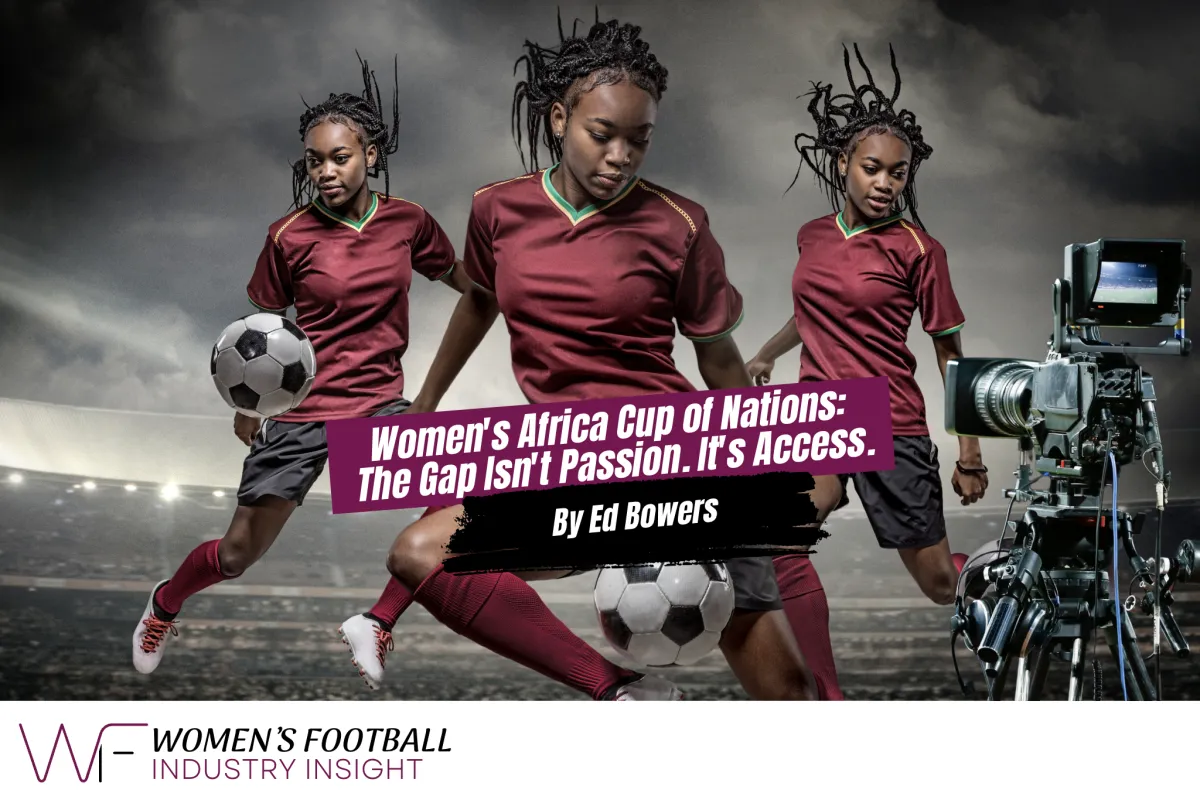
Women's Africa Cup of Nations: The Gap Isn't Passion. It's Access.
Women's Africa Cup of Nations: The Gap Isn't Passion. It's Access.
By Ed Bowers, Director, Women’s Football Industry, Ltd (WFI)
Two football tournaments, a few weeks apart. The Men's World Cup was promoted everywhere — you couldn't escape it if you tried. Then the Women's Africa Cup of Nations kicked off, and it was the complete opposite. I had to hunt for it. That gap is the whole story.
Three years ago, four weeks before the 2023 World Cup, I had a short Q&A interview with Ashleigh Plumptre OON and Carla Humphreys at the BL Ballers Football event in Leicester. I had no idea at the time that one conversation would change how I see this entire game.
Ashleigh was on her way to the World Cup with Nigeria, so I followed her through it. And when the Super Falcons met England in the Round of 16 — a phenomenal match that Nigeria lost on penalties — I found myself researching a team I simply couldn't stop watching.
What I found wasn't just a football team. It was an identity.
Growing up, my sports were tennis and rugby, and the Falcons reminded me of the sides that carry a certain spirituality — the All Blacks and their haka, Fiji's rugby sevens. Watching Nigeria on social media during that World Cup, I saw them weave in music, prayer and ritual. It added a whole new dimension to what it means to support a team, and I was hooked.
Ashleigh put a word to it herself, later, on my podcast: Ubuntu. "There is this collective unspoken belief that we can compete with anyone," she told me. "There is this sisterhood on the field, off the field, unspoken, but felt. And when we play, it's like we will find a way." That line has stuck with me ever since.
Since then I've had the privilege of interviewing both Ashleigh — now playing her club football for Al-Ittihad in Saudi Arabia, and Nigeria's captain, RASHEEDAT AJIBADE OON, OLY , on my podcast — and they let me see that identity from the inside.
Ashleigh told me about the small things. In Australia she noticed the team hotel had crumpets, so she buttered one, added jam, and before long half the squad wanted to know what she was eating. It turned into a ritual — after matches, a group of them would sit together and have a crumpet almost like dessert, just to talk before bed. As insignificant as it sounds, she said, it was the crumpets that brought them together in those moments. That's the stuff you never see on a scoreboard, and it's exactly the stuff that makes me love this game.
When I asked Rasheedat about the music I'd only glimpsed online, she explained it beautifully. In Nigeria, music is heritage. It lifts the spirit before kick-off, and it unites a squad whose players are scattered across the United States, Europe, Saudi Arabia and beyond, each schooled in a completely different footballing culture. When you assemble a team from ten different leagues, that shared identity isn't decoration — it's the glue. She called their ability to fuse all those styles into one their superpower.
Here's the part that's stayed with me.
For the last few years I've been following two competitions side by side. In 2022, I watched the Lionesses win the Euros — consistent coverage, televised games, professional build-up, pundits, the lot. At the very same time, WAFCON was running. To follow Nigeria, all I had were highlights on YouTube and whatever the players posted to Instagram. That was it.
And here's my key point: a core fan will always find a way. But you lose everyone else within seconds if it's too hard. Attention is everything. If people can't find it, they'll find something else — a Netflix binge, another interest — and they're gone.
Now we're doing it again. WAFCON 2026 is underway in Morocco — expanded to 16 teams, with the top four qualifying for next year's World Cup in Brazil, and played under real pressure after the tournament was postponed from March and rescheduled to the summer. Days before kick-off came a big announcement: Channel 4, free-to-air, every match. Progress. Real progress.
Then the first games arrived, and for a lot of us in the UK the coverage simply wasn't there on the day. Thankfully broadcasters elsewhere carried it, and games were watchable on YouTube. The rights got sorted after the backlash — but only if your access allowed it. I could watch from the UK; from Malta, geo-restrictions locked me out and I had to find another way in.
CAF's own account posted a "Where to Watch" graphic a week before kick-off — beIN Sports across MENA, France, APAC and Oceania, Channel 4 in the UK, DAZN in the DACH region, Ziggo in the Netherlands, a run of local broadcasters across the continent, BBC Radio worldwide. Good effort, on paper. Scroll the comments underneath it, though, and you get the real picture: someone asking "is it showing on DSTV?", someone else posting "go on YouTube everyone, you can find it on the channel called Max FM Ghana" — days after the graphic had already gone up — and another simply writing "there is clearly a WORLDWIDE demand for women's soccer, please just stream it worldwide." That's not a coverage list doing its job. That's fans doing the broadcaster's job for them, channel by channel, in the replies.
This is why I'm writing.
Not to point fingers — genuinely, that's not what this is. The interest is there. The teams are there. The Super Falcons won their record 10th title last year with one of the great comebacks, from 2-0 down against the host nation in Rabat, and they're back defending it now — a shaky start this time, beaten by debutants Malawi, before getting their campaign going with a hard-fought first win over Zambia, down to ten players.
Ashleigh later told me what that comeback actually felt like from the inside, and it's stayed with me more than the scoreline ever could. Down 2-0 at half-time in a final, in front of a stadium that was 90 per cent Moroccan fans, she said her first-half performance individually was the worst she'd played in years — so bad that at one point she looked up at the sky mid-match and laughed to herself, certain she was about to be "found out." All she said to herself walking back out for the second half was:
"Let go, and be you." Ashleigh Plumptre OON
Nigeria found something in those 45 minutes nobody on the team could fully explain afterwards, and won 3-2. A few weeks later, Ashleigh was awarded Nigeria's Order of Niger — one of the country's highest honours — for her part in it.
The gap isn't passion. It's the business and professionalism that has to unite what happens on and off the pitch.
I've heard that chain laid out by someone who ran the very top of the sport. When I had Richard Scudamore CBE, the former CEO of the Premier League, on my podcast earlier this year, he defined professional football simply: it's where people are paid to play, and people pay to watch, engage or wear the shirt. If you're in professional football, he said, you're in the economics of sport whether you like it or not. And the whole thing rests on the show being watched.
"Fans are the extras in the film. There's no film without fans." Richard Scudamore CBE
Everything flows from there: the sponsorships, the ticketing, the resources. Pull the broadcast out, and the economics have nothing left to stand on.
He also drew a distinction that's stuck with me: the difference between being international and being global. Doing a thing or two abroad doesn't make you a global business, he told me — if you want to be a global league, you have to think like one, put on the best possible show, and be genuinely sensitive to how each market wants to receive it. When the Premier League struck its NBC deal in the US, the network didn't just buy the rights and disappear behind a paywall. They committed to a set volume of network coverage, cross-promotion on the morning news, even painting New York taxis in the colours of all twenty clubs so people beyond the traditional big-club audience had a way in. Richard's word for what that deal did to US viewership was blunt: it turbo-charged it. Buying the rights was step one. Building the audience was the actual job.
Richard made another point I keep coming back to: control your own destiny. When he arrived, the Premier League's overseas rights were farmed out to agencies. He brought them in-house and sold direct, territory by territory. And it took patience — he waited nine years, turning up outside China's state broadcaster, before a deal finally got done. Progress in this game is rarely instant. But it comes to those who keep showing up.
So over the last couple of weeks I've done one small thing, consistently: I've shared the link to every WAFCON game on my LinkedIn and Instagram, so people at least know where and when to watch. Because if people don't know it's on — or can't find it in a click — they won't go searching. That's just the age we live in. Even some of the federation pages don't post the link to their own stories. A tiny thing. But it makes a huge difference.
And here's the part that makes this whole argument matter to me.
When I asked Rasheedat about "Mission X" — Nigeria's quest for that tenth title — she told me it was never really about the trophy. Before the tournament, the players agreed they would use the victory as a tool for change. Going two goals down in that final could have broken that resolve. It didn't, and she told me exactly why not:
"The game is never, ever over until the final whistle." RASHEEDAT AJIBADE OON, OLY
Not for themselves. For the millions of young girls who look at them as living proof that it's possible. And they meant it: afterwards, the squad took their winnings and gifts out to around 150 grassroots girls' teams across Nigeria, sponsored 25 coaches through the country's National Institute of Sports, and helped cover exam fees for roughly a hundred students. Rasheedat grew up unable to find the couple of pounds she needed just to sit an exam. She took that pain and turned it into a pathway for others.
Ashleigh is doing her own version of this now too. In January she and her Al-Ittihad teammate Franny ran football camps back in Nigeria under her new Ashleigh Plumptre Foundation, built on an idea she's carried since university and calls "Be True": give young people a real way into a hobby, a sport, an experience that helps them work out who they are. Different name to Rasheedat's Mission X, same instinct underneath it — the platform only means something if you do something with it.
That, to me, is what viewership is really for. It's not vanity. Every single viewer is a step in a chain that ends with a nine-year-old girl in Lagos getting a coach who's actually qualified, and a pitch that's actually worth training on.
The players already understand the assignment. They play for more than a shirt, and they've turned their platform into schools, coaches and second chances. The talent has arrived. The stories are extraordinary. Now the access has to catch up.
So I'll keep sharing the links. I'll keep telling these stories. Make it easy to watch — and the rest, as the people who've built the biggest leagues in the world will tell you, tends to follow.
If you're watching WAFCON too, drop the links in your own network. It costs nothing, and it's the simplest way any of us can help this game reach the audience it has already earned.
Conclusion — a few thoughts to take with you:
Interest doesn't guarantee access. WAFCON has the players, the stories and the demand — the Instagram comments prove that. What it's missing is the professional plumbing that turns interest into something findable.
Buying broadcast rights isn't the finish line. Richard Scudamore's point stands: a rights deal without a plan to build the audience around it is just a paywall. The NBC deal worked because NBC promoted it, not just because they paid for it.
Small, consistent actions compound. Sharing a link costs nothing and takes ten seconds, but it's often the only thing standing between a fan and a match they'd have watched if they'd known it was on.
The platform only matters if it's used. Rasheedat's Mission X and Ashleigh's Foundation are two different names for the same idea — visibility that isn't converted into grassroots coaching, exam fees or opportunity is just visibility.
The players have already done their part. Ten Africa Cup titles, a final comeback from 2-0 down, players turning winnings into scholarships — the talent and the character are not in question. The access is what needs to catch up.
You don't need a platform to help. Reposting a link, tagging a broadcaster, telling one person where to watch — it's the simplest, lowest-cost way to close the gap between the game's quality and the audience it deserves.
Women’s Football Industry Ltd (WFI) partners with stakeholders who recognizethat the future of the women’s game depends on decisions made today. We welcome engagement from federations, leagues, investors, and leaders prepared to shape a governance model worthy of women’s football’s potential
